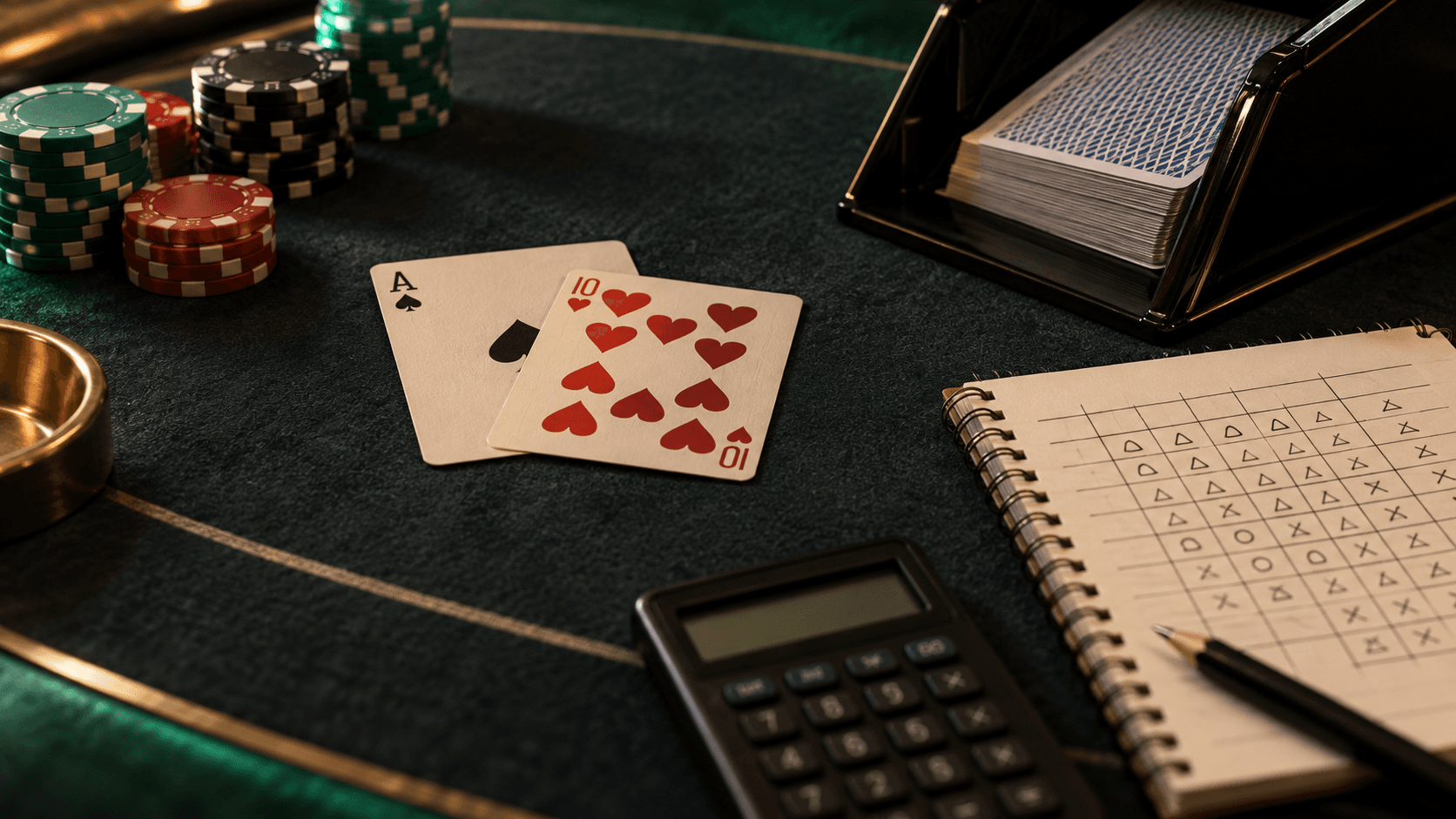
The objective is simple; the decisions are not
You are trying to finish closer to 21 than the dealer without going over. Number cards count at face value, face cards count as 10, and an ace can count as 1 or 11 depending on which keeps the hand live. You can usually hit, stand, double down, and sometimes split a pair. The table rules decide what the dealer must do and how each option is paid.
Read these table rules before looking at the felt
- Dealer hits or stands on soft 17: this changes the house edge because the dealer gets another decision on an ace-plus-six hand.
- Blackjack payout: 3:2 is materially different from 6:5. A reduced payout can erase much of the value of sound play.
- Double-down restrictions: some tables let you double on any first two cards; others limit which totals qualify.
- Late surrender: where offered, surrender rules can reduce the cost of specific difficult hands.
- Deck count and reshuffle: these matter to the underlying game, but a multi-deck online game is not automatically bad or good.
What basic strategy actually does
Basic strategy chooses the mathematically lowest-cost action for each player total, dealer up-card, and rule set. It does not make every hand profitable, remove variance, or turn a 6:5 table into a 3:2 table. Use a strategy chart that matches the exact rules; a generic chart can be wrong around soft totals, splitting, and doubling.
A useful starting map
The number changes with the rules
These are orientation points, not promises. The exact edge changes with the table rules, bet type, strategy, and the published game configuration.
| Game | Typical reference point | What moves the number | Read this first |
|---|---|---|---|
| Blackjack | About 0.5% with good basic strategy | Rules and decisions | Not every table uses the same rules. |
| Baccarat | About 1.06% on banker | Bet selection | The tie bet is usually much worse. |
| European roulette | 2.70% | Wheel layout | The single zero is the key difference. |
| Slots | Game-specific | RTP and volatility | Read the paytable and help screen. |
House edge is an average cost over a large amount of play, not a forecast for the next hand or spin.
Side bets are a separate price
Insurance, perfect pairs, 21+3, lucky ladies, and other side bets may be entertaining, but they are not part of the core blackjack decision. Evaluate each as its own game with its own payout table and house edge. Do not let a rare headline payout obscure the long-run cost of the bet.
Online and live dealer blackjack are not identical
In a digital game, the cards are produced by the game system. In live dealer play, a streamed dealer handles physical cards, but the same table rules, payout, shoe, and limits still matter. Video makes the experience more social; it does not replace checking the license, rules, or dispute route.
For the difference between game feel and game math, read our live dealer guide. For the long-run cost, compare the exact RTP or edge with the House Edge Calculator.
A short pre-play checklist
- Confirm the blackjack payout and dealer soft-17 rule.
- Locate the table help screen and the complete side-bet paytable.
- Set a session budget before choosing a stake.
- Use a rules-matched basic-strategy reference.
- Do not increase a bet to recover a previous hand.
Does basic strategy guarantee a win?
No. It reduces avoidable decision cost over many hands. The dealer still has the mathematical edge under ordinary rules, and short sessions can move sharply in either direction.
Why is 6:5 blackjack a problem?
A blackjack paid at 6:5 returns less than one paid at 3:2. That payout change can materially increase the house edge, so check it before you sit down or open the table.
Should I play side bets?
Only if you understand them as separate wagers with separate math. Do not treat a side bet as part of basic strategy or assume a large top prize means a low house edge.