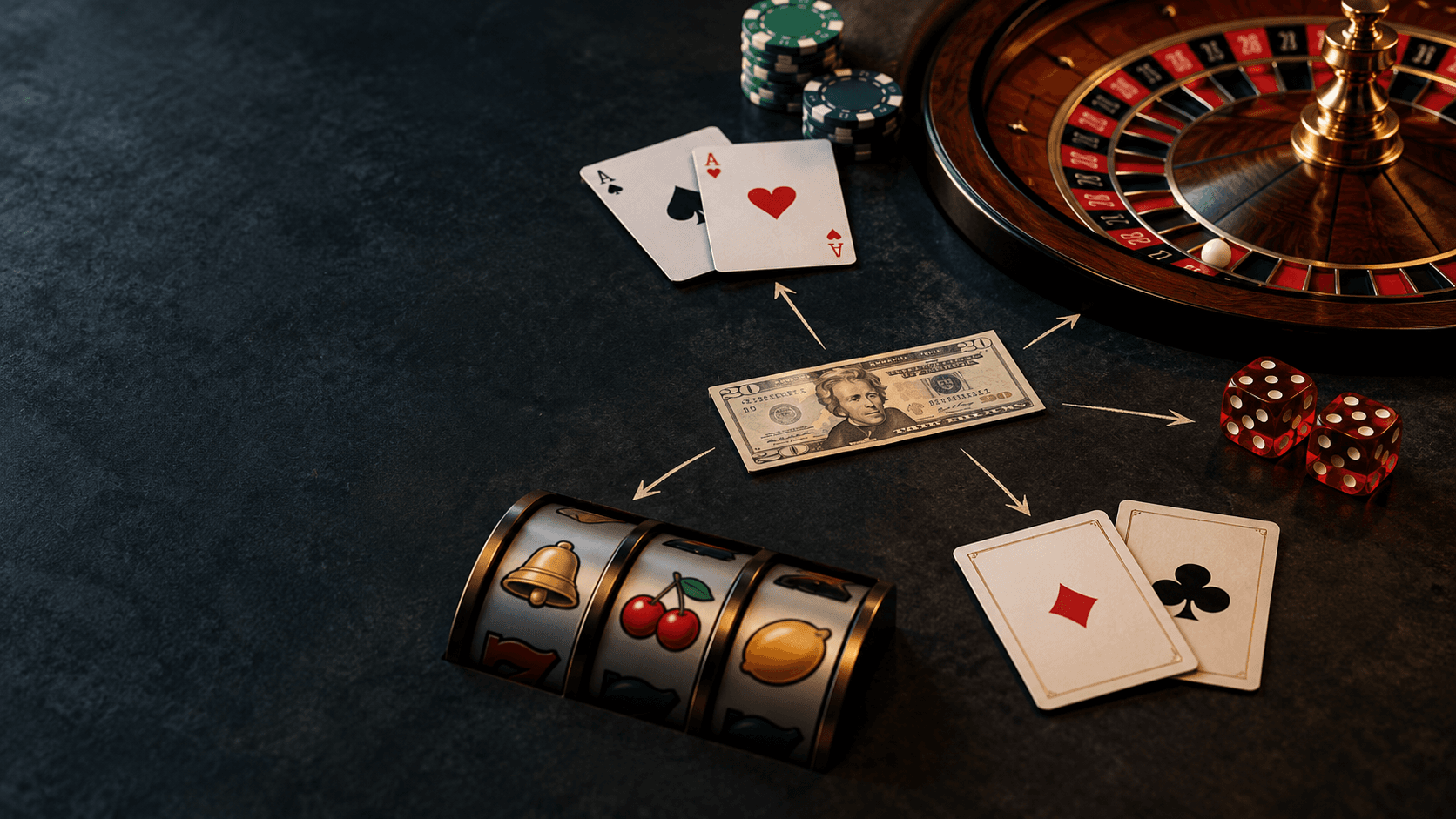
The question is not “Which game is lucky?”
A player can take the same $20 to two games and experience two completely different sessions. One may offer more decisions but a lower illustrative house edge. Another may resolve quickly with no decisions. A third may have a long-run RTP that looks reasonable while producing a much wider spread of short-session outcomes.
The challenge is designed to replace a vague question — “What feels best?” — with four better ones: What is the theoretical price? How quickly do rounds resolve? How much control or decision-making is involved? How wide can the short-run outcomes spread?
The $20 math card
The same budget meets a different theoretical price
Blackjack
Illustrative favorable rules + basic strategy
Baccarat Banker
Standard commission version
Craps Pass Line
Pass Line only; no Odds in this bar
Single-zero roulette
Even-money bet on a 37-slot wheel
96% RTP slot
Long-run average, not one session
Double-zero roulette
Even-money bet on a 38-slot wheel
Run the experiment
Choose a game, run the simplified model, and then change the game while keeping the $20 and twenty $1 units constant. The ending-budget chart is not a forecast of your next session. It is a visual way to see why a long-run average does not describe one short run.
Original casino math lab
The Same $20 Challenge
Hold the starting budget constant. Change the game. See how the theoretical price, pace, volatility, and decision load change the experiment.
Educational simulation
Starting budget
$20
20 × $1 units
Illustrative edge
0.50%
About $0.10 expected cost
Volatility
Medium
Outcome spread
Pace
Medium
Rounds can compound cost
Decisions
High
Choices per round
Model note: Simplified $1-unit model using a favorable-rule, basic-strategy-style edge. Real rules can move this materially. This lab holds the unit size and session length constant so the comparison is readable. It does not recreate a casino, predict your result, or make a game “safe.”
Ending-budget spread
500 illustrative sessions
Each starts at $20
This distribution is generated from the simplified model above. A real game’s rules, strategy, volatility, bet size, table minimum, and number of rounds can change the shape.
Average ending balance
$19.67
Model average, not a promise
Median ending balance
$20.00
Middle simulated session
Finished at $0
0.0%
Within this simplified 20-unit lab
Ended above $20
38.4%
Not the same as long-run value
Privacy note: the simulation runs in your browser and does not send or save inputs. It is educational probability content, not gambling advice, a strategy, a guarantee, or a recommendation to play.
Why the same $20 behaves differently
House edge
The long-run average cost of the wager under a specified configuration. A 4% edge does not remove 4% from every session; it describes an average over a very large amount of play.
Volatility
The shape of the outcomes around the average. A higher-volatility game can produce larger swings, longer quiet periods, or occasional large wins without changing the underlying price.
Pace
How often a new result can be generated. Faster rounds can expose the same budget to more decisions and more outcomes in less time.
Decision load
How much the player must choose. More decisions can be meaningful, but they can also create more room for mistakes, side bets, and pressure.
Game by game: what the challenge is showing
Blackjack: a lower edge can come with more responsibility
Blackjack is not one fixed number. Rules such as blackjack payout, number of decks, dealer action on soft 17, doubling and splitting rules, and surrender can change the edge. Decisions matter too: basic strategy can reduce mistakes under the correct rules, but it cannot turn a session into a guarantee. Side bets are separate propositions and can carry a very different price.
That is why the challenge labels its blackjack model as illustrative rather than universal. Read the exact table rules and use our rule-matched blackjack guide if you want to understand the decisions separately.
Baccarat Banker: simpler decisions, a commission to remember
The standard Banker bet is often discussed because its mathematical price is lower than the Player or Tie bet in common commission versions. The commission is not a footnote; it is part of the payout structure that creates the edge. The challenge excludes Tie and side bets so the comparison does not quietly mix different bets.
See the baccarat strategy and house-edge guide for the Banker, Player, Tie, commission, and streak-chart questions.
Craps Pass Line: the table has many bets, but they are not one price
Craps can look like a single game while offering many separate bets. The Pass Line has one commonly cited edge; proposition bets, Field, Hardways, and other options have their own prices. Odds bets can be mathematically fair after a point but still increase the amount exposed to the table. The challenge uses the Pass Line only to keep the comparison understandable.
Our craps guide explains the table without pretending every available bet is equally sensible.
Roulette: the extra zero is not decoration
Single-zero and double-zero wheels look similar, and the common even-money bets feel identical, but the extra zero changes the long-run price. On a single-zero wheel there are 37 slots; on a double-zero wheel there are 38. The challenge keeps the bet simple so the wheel difference is visible rather than hidden behind a complicated system.
Changing red to a number, a dozen, or a system does not remove the wheel edge. It changes the size and frequency of outcomes.
Slots: RTP is not a session refund
A slot with 96% RTP does not promise that a $20 session returns $19.20. The UK Gambling Commission explains that RTP is an average across a significant number of plays, not an amount delivered on each session. Volatility and the paytable determine how widely short runs can move around that average.
The slot model in the tool is intentionally stylized. It is a teaching device for spread and pace, not a replica of a named game or a claim about any operator’s machine.
What the $20 challenge does not control
- Table minimums: a $20 budget may not buy twenty $1 rounds at a live table.
- Rule variants: blackjack, baccarat, roulette, and craps change materially with rules and bet type.
- Side bets: the headline game and its side bets are not the same wager.
- Speed: a real session can expose the budget to more or fewer rounds than the model.
- Human decisions: the simulation does not model tilt, chasing, distractions, or mistakes.
- Bonuses: promotions introduce rollover, contribution, maximum-bet, and expiry rules that can change the practical price.
Use the RTP and volatility guide for the statistical vocabulary, the House Edge Calculator for a simpler theoretical-cost calculation, and the Session Budget Calculator for a hard spending boundary.
The useful takeaway is a question, not a winner
Before a session, ask: What exact rules am I playing? How much can one round cost? How quickly will the next decision arrive? Is the game’s volatility compatible with my fixed budget? Am I choosing the bet because I understand it, or because a recent result made it feel due?
The $20 is a teaching constraint. It is not an invitation to turn the experiment into a target, a chase, or a promise that one game is “best.” The only result the lab can guarantee is a clearer view of the assumptions.
Is blackjack always the cheapest casino game?
No. Its edge depends on the exact rules and the decisions made. A favorable table played poorly can be more expensive than the label suggests, and side bets are separate propositions.
Why does roulette have a higher price even when red feels close to 50/50?
The zero spaces do not pay as winning red or black outcomes. They create the gap between the even-money payout and the true wheel probability.
Does a high-volatility slot have a worse RTP?
Not necessarily. RTP and volatility describe different things: long-run average return versus the spread and rhythm of outcomes. A high-volatility game can have the same stated RTP as a lower-volatility game.
Can I use this to choose a game to play?
Use it to understand the trade-offs, not as a recommendation. Check the exact rules, budget boundary, local legality, and responsible-gambling resources separately.